Originally the square was a pleasant garden and open area for gentlemen’s carriages waiting at the railway station. The square is now the location for the town’s War Memorial dating to 1921, which was designed by L S Merrifield. It takes it’s name from Redburn House, home of Lt John Spencer Dunville of the Royal Dragoons Holywood’s only recipient of the Victoria Cross.
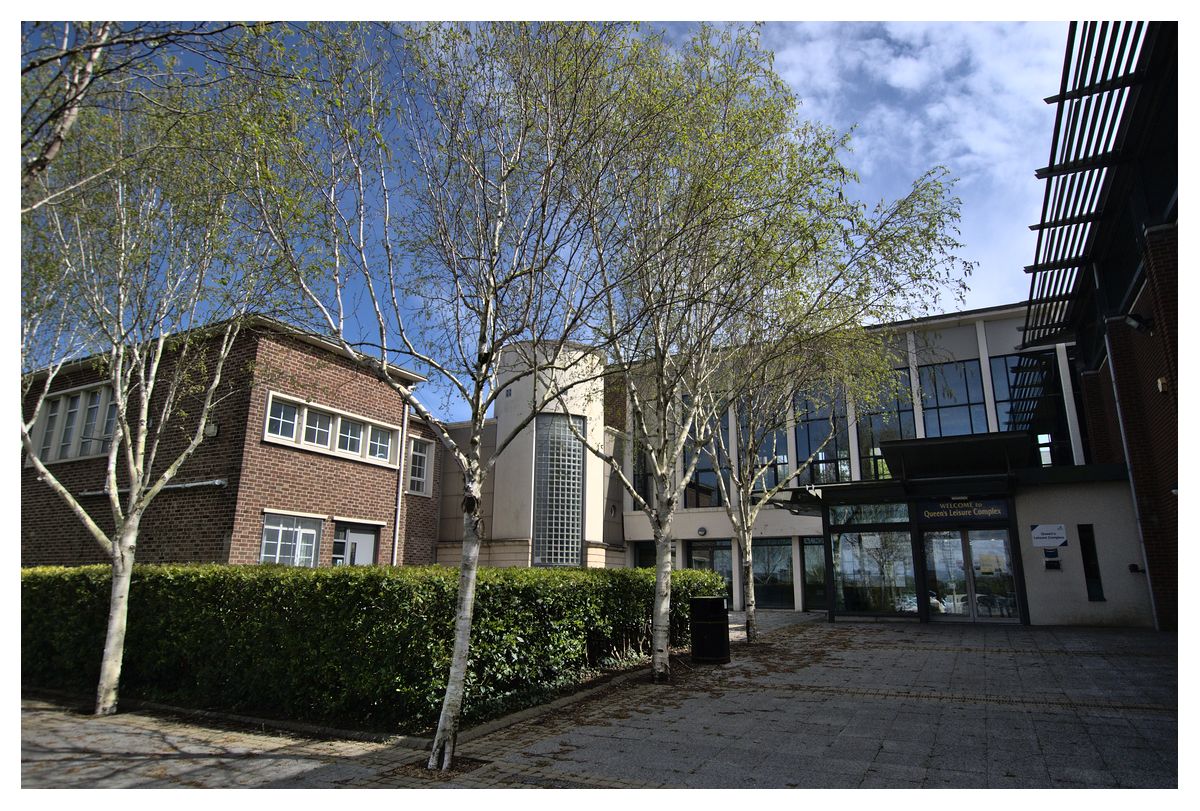
Just beyond the Fire Station are Queen’s Hall & Queen’s Leisure Complex. The hall, built in 1953 and leisure centre opened in 2000 are Holywood’s main civic buildings. A tourist information point is located at the leisure complex.
The first post-Reformation Catholic Church in Holywood was St Patrick’s in Church View which was consecrated in 1830. However, to meet the growth in the congregation Timothy Hevey was commissioned by Monsignor O’ Laverty, the parish priest, to design a much larger church on a prominent site overlooking the road into Belfast. This was in a most beautiful French Gothic style, and consisted of a nave and chancel with a lofty tower to one side, which was consecrated in 1874. The spire was added in 1891.
Sadly the church was totally destroyed by fire in August 1989 although the tower survived. The new church, which was dedicated in 1995, is circular and the belfry tower was retained. One of the most striking features of the new church is the natural light in the interior space.
Holywood Library, a listed building, was founded as primary and secondary schools in the 1860’s. Formerly known as the Sullivan Schools, it was where the renowned 20th century naturalist and historian Robert Lloyd Praeger and his sister Sophia Rosamond Praeger began their education.
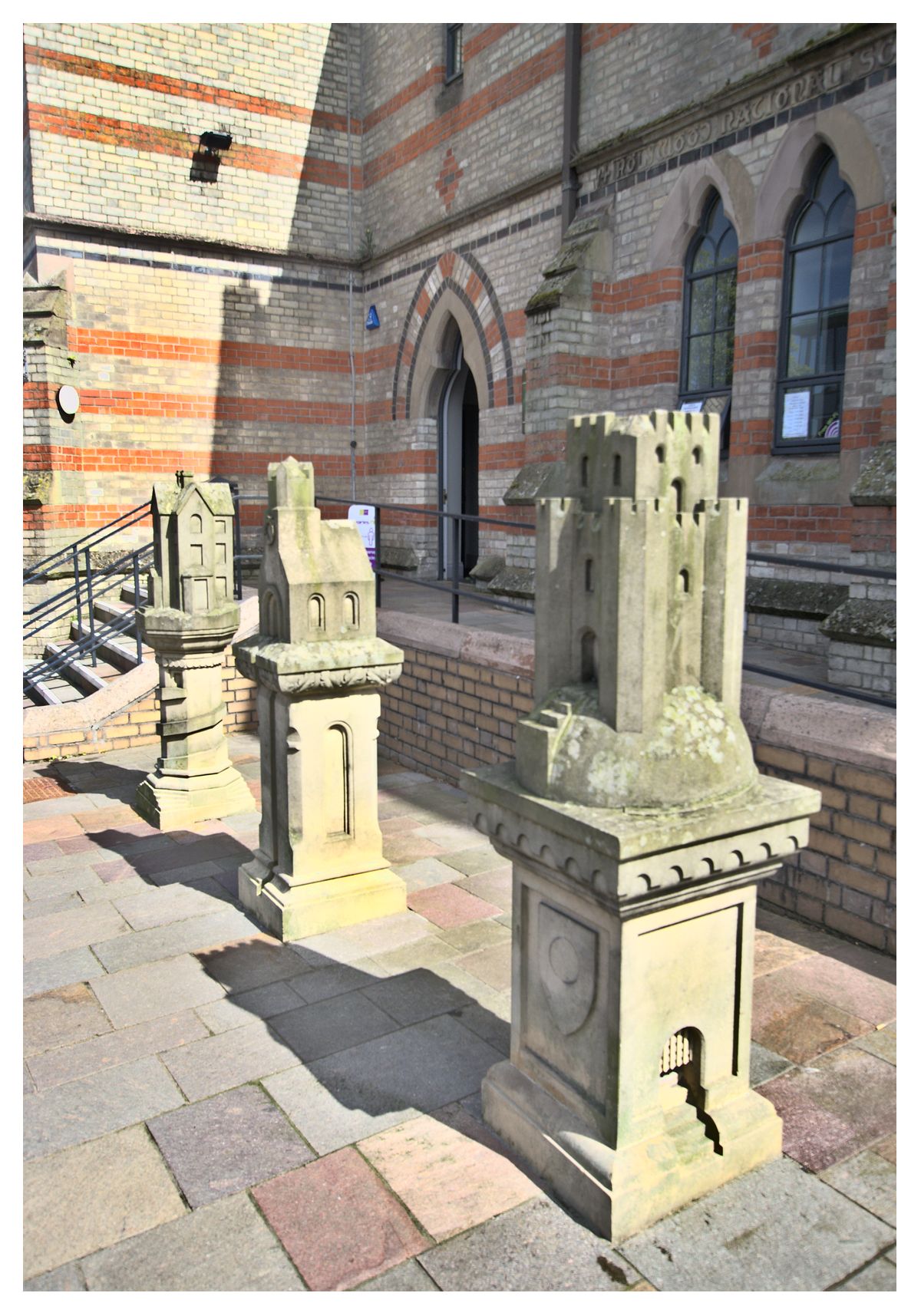
Outside the library you can see three sculptures entitled the “Pillars of Holywood” by Tim Shutter, who has worked with Anthony Gormley on a commission for the British Library. The sculptures, which were commissioned by Holywood Arts Trust and received funding through the Arts Council of Northern Ireland Lottery through the Public Art Programme, depict the legacy of the town’s 1,400-year history from the 7th century church, to the invasion of the Anglo-Normans in the 12th century and the domicile of the wealthy Belfast industrialists of the 19th century.
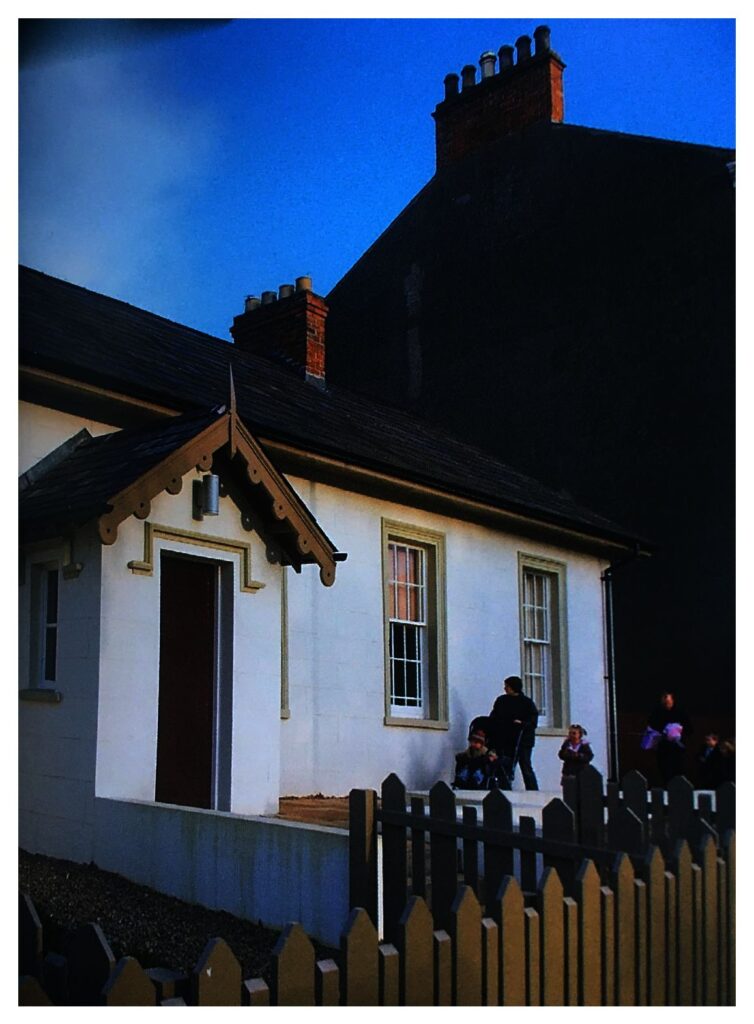
The listed Old School Building (1845) been restored with Heritage Lottery funding and the support of the local community. It is said that the wonderful roof timbers were taken from the then redundant Old Priory, which you have already visited. It is now a resource for all and is used for meetings, concerts, the scouts, family parties and much more.
Opposite the Old School is the Parish Church of St Philip and St James. The overcrowding in the Old Priory Church in the late 1830s had forced the Church of Ireland to seek alternative accommodation and the decision was made to erect a completely new Parish Church here was taken in April 1842.
Charles Lanyon who was already undertaking a major Church building programme for the Diocese of Down, Connor & Dromore was appointed as the architect. The new Church was consecrated in 1844. However it also became too small for the rapidly expanding town and in 1869 it was enlarged by building a new nave and north aisle and converting the original structure into the south aisles That is why the tower and spire are at the end of what is now an aisle, instead of the more usual position at the end of the nave. If you walk round to the far side of the Church the difference between the original and the extension is clear to see.
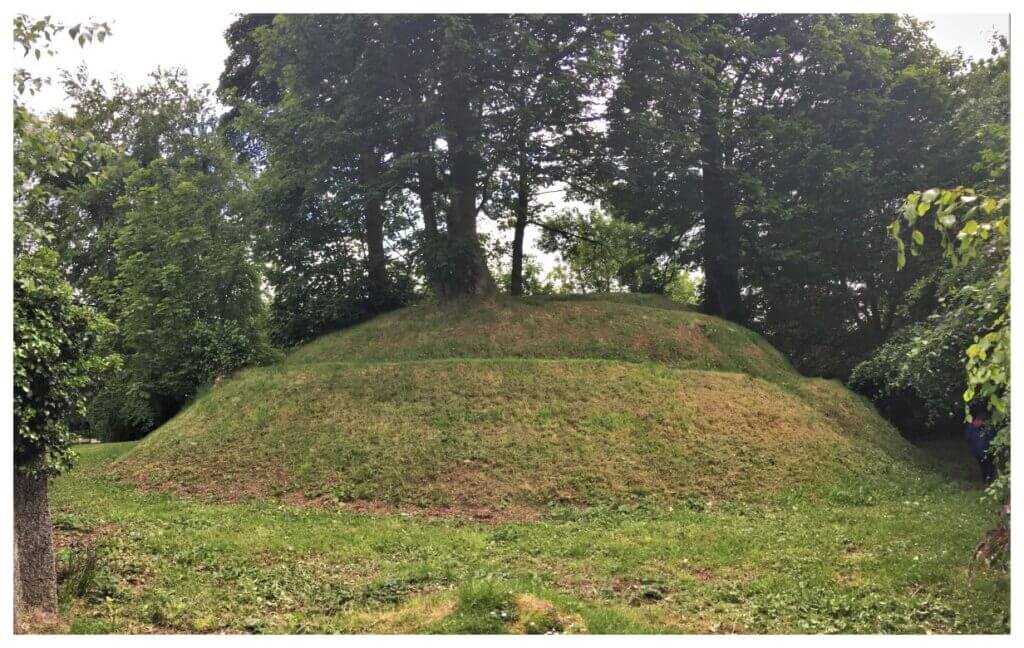
When the Normans invaded Ulster in the 12th century fortifications such as Holywood Motte were widely seen across the land. King John passed through Holywood in 1210 on his journey from Carrickfergus to Dublin. He is said to have “spent the night” of Thursday July 29 in the Government Bailey situated on the Motte before heading on to Dundonald by way of Victoria Road and Croft Road (formally King John’s Highway) to stay at Dundonald Motte (where he lost 2 pence playing cards!).
The statue is the work of local sculptress Sophia Rosamond Praeger. Her delightful bronze statue of a youngster playing the accordion was cast as a gift to the town and erected in 1953. The original sculpture in the North Down Museum in Bangor was created to commemorate a local Boy Scout named Fergus Morton who was killed in a road accident while doing ‘Bob a Job’ in 1952.
Beside the statue is a blue plaque to commemorate the birthplace of Robert Sullivan, one of Irelands outstanding educationalists.
The town’s rich ecclesiastical heritage is represented today by its most distinctive building, the Old Priory. The site was formally a monastery founded by St Laiseran in the early 7th century. The ruins you see today are that of the 12th century Anglo-Norman Augustinian Abbey. Henry VIII dissolved the Priory in 1541 with its lands passing into the hands of the O’Neill family and then to Sir James Hamilton, First Viscount Clandeboye. Hamilton laid out the town, with a Maypole at the crossroads and most of the early buildings are clustered round the Priory. The tower, however, dates from 1809 (the date marked on the original clock now in the current Parish Church) when this was the site of the town’s Parish Church. The graveyard has some interesting “residents” including members of the Praeger family, the Dunvilles (of whiskey fame) and Sir Joseph Larmor the world famous mathematician. When facing the Priory, across the road on your right, you will see First Holywood Presbyterian Church (1842).
Holywood’s Maypole is the only one surviving in Ireland today and early maps show a Maypole has stood on the site since the 1620’s. Today it is still the focus of the town’s annual May Day Celebrations and fair, when local school children dance around the Maypole alongside market stalls and family attractions.
We use cookies on our website to give you the most relevant experience by remembering your preferences and repeat visits. By clicking “Accept”, you consent to the use of ALL the cookies.
This website uses cookies to improve your experience while you navigate through the website. Out of these, the cookies that are categorized as necessary are stored on your browser as they are essential for the working of basic functionalities of the website. We also use third-party cookies that help us analyze and understand how you use this website. These cookies will be stored in your browser only with your consent. You also have the option to opt-out of these cookies. But opting out of some of these cookies may affect your browsing experience.
Necessary cookies are absolutely essential for the website to function properly. These cookies ensure basic functionalities and security features of the website, anonymously.
Cookie
Duration
Description
cookielawinfo-checbox-analytics
11 months
This cookie is set by GDPR Cookie Consent plugin. The cookie is used to store the user consent for the cookies in the category "Analytics".
cookielawinfo-checbox-functional
11 months
The cookie is set by GDPR cookie consent to record the user consent for the cookies in the category "Functional".
cookielawinfo-checbox-others
11 months
This cookie is set by GDPR Cookie Consent plugin. The cookie is used to store the user consent for the cookies in the category "Other.
cookielawinfo-checkbox-necessary
11 months
This cookie is set by GDPR Cookie Consent plugin. The cookies is used to store the user consent for the cookies in the category "Necessary".
cookielawinfo-checkbox-performance
11 months
This cookie is set by GDPR Cookie Consent plugin. The cookie is used to store the user consent for the cookies in the category "Performance".
viewed_cookie_policy
11 months
The cookie is set by the GDPR Cookie Consent plugin and is used to store whether or not user has consented to the use of cookies. It does not store any personal data.
Functional cookies help to perform certain functionalities like sharing the content of the website on social media platforms, collect feedbacks, and other third-party features.
Performance cookies are used to understand and analyze the key performance indexes of the website which helps in delivering a better user experience for the visitors.
Analytical cookies are used to understand how visitors interact with the website. These cookies help provide information on metrics the number of visitors, bounce rate, traffic source, etc.